📥📥📥 900Mb
📥📥📥 1.7Gb
🎬 Movie Review: Rush (2013) – A Thrilling Portrait of Rivalry, Ambition and Survival
⭐ Quick Review Overview
| Category | Details |
|---|---|
| Movie | Rush |
| Release Year | 2013 |
| Language | English |
| Genre | Biography / Sports / Drama |
| Director | Ron Howard |
| Writer | Peter Morgan |
| Lead Actors | Chris Hemsworth, Daniel Brühl |
| Music | Hans Zimmer |
| Cinematography | Anthony Dod Mantle |
| Editing | Daniel P. Hanley, Mike Hill |
| Runtime | 2h 3m |
| Based On | James Hunt & Niki Lauda’s Formula 1 rivalry |
| Overall Rating | ⭐⭐⭐⭐⭐ 4.5/5 |
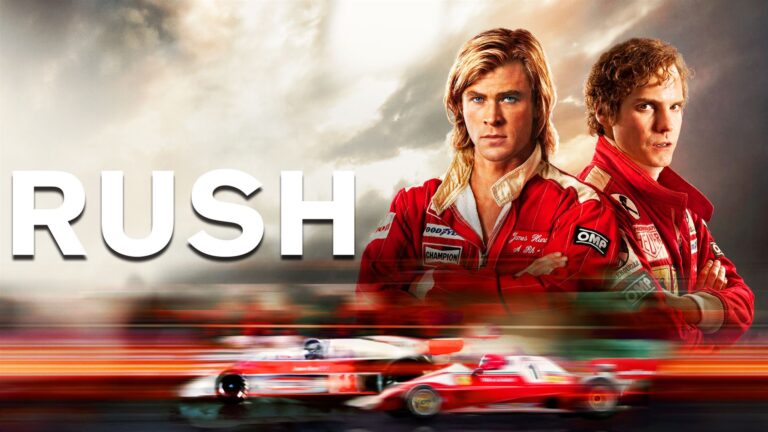
Rush is much more than a Formula 1 movie. At its heart, it is a character-driven drama about two completely different men who become obsessed with defeating each other.
Ron Howard’s 2013 film dramatizes the legendary rivalry between British playboy James Hunt and Austrian perfectionist Niki Lauda, particularly during the 1976 Formula 1 season.
Even viewers who know very little about Formula 1 can enjoy the film because the real focus isn’t simply on who wins the races—it is on why these two men race.
📖 Storyline & Narrative
The film follows two drivers who couldn’t be more different.
James Hunt is charismatic, impulsive, fearless and obsessed with living life to the fullest.
Niki Lauda, meanwhile, is disciplined, analytical, serious and extraordinarily methodical.
Their rivalry begins before they reach the highest level of Formula 1, but once they enter the sport’s elite, their contrasting personalities make their competition increasingly intense.
Hunt races through instinct and aggression.
Lauda races through preparation, calculation and technical understanding.
Neither man is willing to accept second place.
The story eventually reaches its most dramatic stage during the 1976 Formula 1 season, when Lauda suffers a devastating crash at the Nürburgring and sustains severe burns.
What follows transforms their rivalry.
The film becomes a story about:
- Competition
- Courage
- Obsession
- Fear
- Survival
- Friendship
- Sacrifice
- The price of greatness
The extraordinary part is that the film doesn’t turn either driver into a conventional hero or villain.
Hunt needs Lauda. Lauda needs Hunt.
Their rivalry pushes both men to become better drivers.
🎭 Performances
⭐ Chris Hemsworth – James Hunt
Chris Hemsworth gives one of the most interesting performances of his career as James Hunt.
This is very different from his larger-than-life superhero persona as Thor.
Hemsworth captures Hunt’s:
- Confidence
- Recklessness
- Charm
- Sexual charisma
- Competitive aggression
- Emotional vulnerability
He makes Hunt feel like a man who genuinely enjoys danger.
But the performance also reveals the insecurity underneath that confidence.
Hemsworth doesn’t merely play Hunt as a glamorous racing star. He gives the character enough emotional complexity to make his relationship with Lauda believable.
Rating: ⭐⭐⭐⭐⭐
⭐ Daniel Brühl – Niki Lauda
Daniel Brühl is exceptional.
In many ways, Lauda becomes the emotional centre of the film.
Brühl captures his meticulous personality, blunt communication style and almost obsessive commitment to racing.
But the performance becomes extraordinary after Lauda’s crash.
His physical transformation and psychological struggle make the second half considerably more powerful.
Brühl’s portrayal earned him major awards attention, including a Golden Globe nomination.
Rating: ⭐⭐⭐⭐⭐
⭐ Olivia Wilde – Suzy Miller
Olivia Wilde plays James Hunt’s first wife, Suzy Miller.
Her role is relatively small compared with the two protagonists, but she helps establish Hunt’s lifestyle and personal relationships.
⭐ Alexandra Maria Lara – Marlene Lauda
Alexandra Maria Lara brings warmth and emotional grounding as Marlene Lauda.
Her relationship with Niki becomes especially important after the accident.
⭐ Pierfrancesco Favino – Clay Regazzoni
Favino gives a strong supporting performance as Ferrari driver Clay Regazzoni.
He also contributes to the film’s depiction of the competitive Formula 1 environment.
🎬 Direction & Screenplay
Ron Howard
Ron Howard makes a smart decision by not making the film exclusively about racing.
Instead, the racing becomes the framework through which the personalities of Hunt and Lauda are explored.
Peter Morgan’s screenplay is particularly effective because it gives both men opposing philosophies.
Hunt believes in enjoying life.
Lauda believes in controlling every possible variable.
That philosophical conflict makes even conversations outside the racetrack feel competitive.
The screenplay also avoids making the rivalry simplistic.
Lauda isn’t simply “the serious one.”
Hunt isn’t simply “the reckless one.”
Both have strengths.
Both have weaknesses.
And both have moments where their philosophy proves correct.
🏎️ Formula 1 Racing Sequences
This is where Rush becomes exceptional.
The racing scenes are intense, dangerous and visceral.
Anthony Dod Mantle’s cinematography puts the viewer extremely close to the cars.
The film makes 1970s Formula 1 feel genuinely terrifying.
These weren’t the heavily computer-controlled, highly regulated machines of modern Formula 1.
The drivers were effectively sitting inside extremely fast machines with enormous physical risks.
The film uses that danger brilliantly.
You don’t simply watch the cars go around a circuit.
You feel:
speed → pressure → fear → impact.
And the Nürburgring sequence is particularly unforgettable.
📷 Cinematography
Anthony Dod Mantle
The cinematography is one of the film’s biggest achievements.
The camera work constantly changes depending on the situation.
During races, the camera becomes energetic and unstable.
During quieter character moments, the visuals become more controlled.
The 1970s period atmosphere is also beautifully recreated.
The result is a film that feels both authentic and cinematic.
Rating: ⭐⭐⭐⭐⭐
🎵 Music & Background Score
Hans Zimmer
Hans Zimmer’s score is phenomenal.
The music doesn’t merely accompany the racing.
It creates tension.
The soundtrack combines Zimmer’s original score with period rock music, including songs associated with artists such as David Bowie, Thin Lizzy and others.
The score gives the movie a constant feeling of momentum.
Even scenes away from the racetrack retain a sense of impending competition.
Rating: ⭐⭐⭐⭐⭐
✂️ Editing
Daniel P. Hanley and Mike Hill keep the movie moving at an impressive pace.
Despite covering several years of the drivers’ careers, the film never feels like a conventional historical biography.
The editing particularly shines during the racing sequences.
The film jumps between:
- Driver
- Car
- Track
- Crowd
- Pit crew
- Competitor
without becoming confusing.
The result is a very accessible racing movie even for someone unfamiliar with Formula 1.
Rating: ⭐⭐⭐⭐½/5
🧠 Critical Analysis
The greatest achievement of Rush is that the rivalry is more important than the racing.
At first glance, the film appears to be about determining which driver is better.
But gradually, it becomes clear that Hunt and Lauda define each other.
James Hunt represents instinct.
He trusts his ability to react.
Niki Lauda represents discipline.
He trusts preparation and calculation.
Neither philosophy is completely right.
That’s what makes their relationship fascinating.
The film also explores the relationship between greatness and self-destruction.
Hunt’s lifestyle constantly threatens his career.
Lauda’s obsession with perfection nearly costs him his life.
Both men are willing to risk extraordinary amounts for victory.
And the film asks an important question:
How much should a person sacrifice to become the best?
🔥 The Nürburgring Crash
The Nürburgring crash is the film’s emotional turning point.
Lauda’s accident isn’t presented merely as a spectacular disaster.
The film focuses on what comes afterward.
His injuries.
His pain.
His fear.
His determination to return.
And the psychological battle involved in getting back into a racing car.
This section transforms Rush from an entertaining sports drama into something much more emotionally powerful.
⏱️ First Half vs Second Half
⭐ First Half – 4.5/5
The first half establishes the rivalry beautifully.
We understand exactly who Hunt and Lauda are and why they dislike each other.
The racing scenes are already excellent, but the character development is equally important.
The pacing is energetic and entertaining.
⭐ Second Half – 5/5
The second half is where the film reaches another level.
Lauda’s crash completely changes the emotional atmosphere.
His comeback creates enormous tension, while Hunt’s championship challenge becomes increasingly important.
The 1976 season provides the perfect dramatic structure.
And the final stages are incredibly satisfying because the film isn’t simply about victory.
It’s about respect.
❤️ The Relationship Between Hunt & Lauda
One of the film’s most impressive elements is how the relationship evolves.
They begin as rivals.
Then they become enemies.
Then competitors.
Then something closer to friends.
Neither man would openly admit how important the other is.
But both understand that the other person has pushed them beyond their limits.
That’s why the final emotional impact works so well.
They needed each other to become who they were.
✅ What Works
- ⭐ Outstanding Chris Hemsworth performance
- ⭐ Exceptional Daniel Brühl performance
- ⭐ Brilliant rivalry between Hunt and Lauda
- ⭐ Superb Formula 1 racing sequences
- ⭐ Excellent direction by Ron Howard
- ⭐ Powerful Hans Zimmer score
- ⭐ Stunning cinematography
- ⭐ Strong screenplay by Peter Morgan
- ⭐ Excellent 1970s period recreation
- ⭐ Emotional Nürburgring sequence
- ⭐ Strong character development
- ⭐ Works even for non-F1 viewers
- ⭐ Excellent balance between sports and human drama
❌ What Doesn’t Work
- ⚠️ Some historical events are simplified or dramatized
- ⚠️ Certain supporting characters receive limited development
- ⚠️ Some aspects of Hunt’s personal life are compressed
- ⚠️ The screenplay occasionally prioritizes dramatic impact over complete historical accuracy
These are relatively minor issues considering how effectively the movie works as a dramatic retelling.
🏆 Final Verdict: Is Rush Worth Watching?
Absolutely.
Rush is one of the best sports biographical dramas of the 2010s.
You don’t need to understand Formula 1 to appreciate it.
You don’t even need to know who James Hunt or Niki Lauda were before watching it.
Ron Howard takes a specific sporting rivalry and transforms it into a universal story about ambition, ego, fear, survival and respect.
Chris Hemsworth is excellent.
Daniel Brühl is outstanding.
Hans Zimmer’s music is unforgettable.
The racing sequences are spectacular.
And the emotional payoff is genuinely powerful.
Most importantly, Rush understands something many sports movies forget:
The greatest competition isn’t always between two teams. Sometimes it’s between two personalities who bring out the best—and worst—in each other.
⭐ Final Rating: 4.5/5
Story: ⭐⭐⭐⭐⭐
Performances: ⭐⭐⭐⭐⭐
Direction: ⭐⭐⭐⭐⭐
Screenplay: ⭐⭐⭐⭐½
Cinematography: ⭐⭐⭐⭐⭐
Music: ⭐⭐⭐⭐⭐
Editing: ⭐⭐⭐⭐½
Racing Sequences: ⭐⭐⭐⭐⭐
Emotional Impact: ⭐⭐⭐⭐⭐
Historical/Period Atmosphere: ⭐⭐⭐⭐½
🎯 Final Verdict
🏁 A gripping, beautifully acted and emotionally powerful Formula 1 drama. Rush is not just about winning races—it is about the extraordinary relationship between two men who refused to let each other lose.
⭐ MUST WATCH — 4.5/5