📥 900Mb
📥 1.4Gb
[url_article_extractor]
🎬 Movie Review: The Runner (2026)
A fast-paced mother-versus-time thriller that runs out of suspense
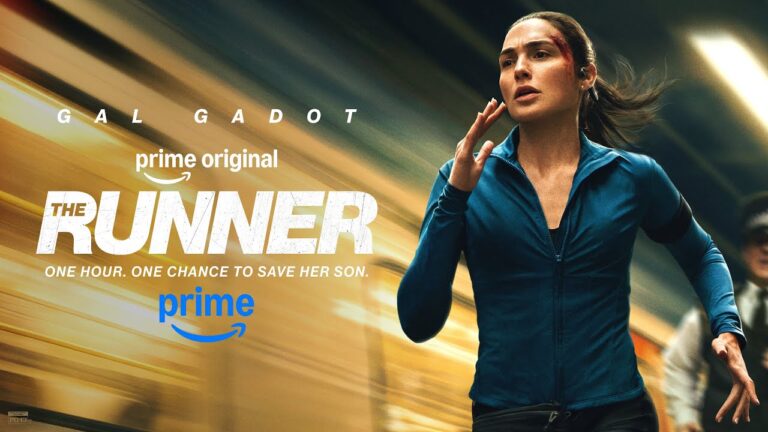
The Runner is a 2026 English-language psychological action thriller directed by Kevin Macdonald and written by Mark Gibson. The film stars Gal Gadot as Maia Marten, with Damian Lewis, Rory Wilmot and Alfred Enoch in supporting roles. It premiered on Prime Video on September 2, 2026, and has a compact runtime of about 84–85 minutes. (IMDb)
The premise is simple: a London lawyer receives a terrifying call during her morning run—the caller has kidnapped her son. To save him, she must keep running across London, follow a series of instructions and avoid trusting anyone. (Rotten Tomatoes)
⭐ Quick Review Overview
| Category | Rating |
|---|---|
| Story | ⭐⭐⭐ |
| Screenplay | ⭐⭐ |
| Direction | ⭐⭐⭐ |
| Performances | ⭐⭐⭐ |
| Action | ⭐⭐⭐ |
| Thriller Factor | ⭐⭐½ |
| Cinematography | ⭐⭐⭐½ |
| Music & BGM | ⭐⭐⭐ |
| Editing | ⭐⭐⭐ |
| Climax | ⭐⭐½ |
| Overall | ⭐⭐½ / 5 |
📖 Storyline
Maia Marten is a successful London lawyer and a single mother. Her seemingly ordinary morning run suddenly turns into a nightmare when she receives a call informing her that her young son Noah has been abducted.
The instructions are brutally simple:
Keep running. Follow the commands. Don’t tell anyone.
The caller forces Maia to race through London while giving her increasingly dangerous tasks.
The film’s central hook is that Maia isn’t merely trying to find her son—she is being forced to participate in a deadly game while the clock is ticking.
One of the major tasks involves forcing Maia to kill a key witness connected to her legal work. (The Guardian)
That creates the film’s central moral question:
How far would a mother go to save her child?
It’s a strong setup for a contained thriller.
Unfortunately, the execution doesn’t always match the potential of the premise.
👥 Cast & Performances
⭐ Gal Gadot as Maia Marten
Gal Gadot carries almost the entire movie.
This is a physically demanding performance because Maia spends much of the film running, escaping, fighting and reacting to increasingly impossible situations.
Her physical commitment is convincing. Gadot reportedly underwent extensive running training for the role and even finished filming on crutches after suffering foot injuries. (People.com)
The problem is that the character requires considerable emotional depth, and this is where the performance becomes less convincing.
The audience needs to desperately feel Maia’s fear for her son.
Instead, some scenes feel emotionally distant.
Physically impressive, emotionally uneven.
⭐ Damian Lewis as The Caller
Damian Lewis has one of the film’s most intriguing roles.
His character is mostly heard rather than seen, which could have created a genuinely terrifying psychological presence.
Unfortunately, the screenplay doesn’t give him enough material.
The mysterious voice is effective initially, but the villain eventually feels more generic than threatening. Several critics also felt Lewis was underused. (Reddit)
⭐ Rory Wilmot as Noah
Rory Wilmot plays Maia’s kidnapped son.
Although his screen time is limited by the nature of the story, Noah’s situation provides the emotional motivation for practically everything Maia does.
⭐ Alfred Enoch as Ted
Alfred Enoch provides supporting presence in the story, although his character doesn’t receive enough development to make a major impression.
🎬 Direction
Kevin Macdonald, the director of The Last King of Scotland and Black Sea, attempts to turn a relatively simple premise into a real-time urban thriller.
The decision to use London itself as part of the chase is smart.
Maia runs through streets, public spaces and transport locations, giving the film a sense of constant movement.
However, the direction sometimes becomes too frantic.
Instead of making the audience feel Maia’s panic, the rapid camera movements and stylistic choices can become distracting.
The Guardian particularly criticised the film’s frenetic visual style, calling it dated rather than genuinely immersive. (The Guardian)
🏃 Action & Thriller Elements
The movie’s greatest advantage is its simple race-against-time structure.
There is very little wasted setup.
Once the situation begins, the film moves quickly from one location to another.
There are:
- 🚨 Chases
- 🏃 Running sequences
- 🔪 Threats
- 🚇 Urban pursuit sequences
- 📱 Technology-based surveillance
- ⏱️ Countdown tension
- 👤 A mysterious antagonist
The subway chase is among the more notable set pieces. Rotten Tomatoes’ current listing also highlights it as one of the film’s featured action sequences. (Rotten Tomatoes)
But the action doesn’t always generate the intensity it should.
The basic idea feels like a combination of familiar real-time thriller formulas, and critics have repeatedly compared its structure to movies such as Nick of Time, Eagle Eye, Red Eye and more recently Carry-On. (San Francisco Chronicle)
📷 Cinematography
London is arguably the film’s best supporting character.
The filmmakers use:
- Busy streets
- Underground stations
- Bridges
- Parks
- Modern buildings
- Crowded public spaces
to make Maia’s journey feel like a continuous obstacle course.
The city gives the movie scale without requiring a huge production.
However, the aggressive camera work doesn’t always help.
Some critics felt the visual style was unnecessarily frantic and reminiscent of early-2000s action filmmaking. (San Francisco Chronicle)
⭐ Cinematography: 3.5/5
🎵 Music & Background Score
Tom Hodge composed the score. (pro.imdb.com)
The music attempts to maintain constant urgency.
That makes sense for a film built around a ticking clock, but the score sometimes feels like it’s forcing tension instead of creating it naturally.
The best thriller scores allow silence and anticipation to do some of the work.
Here, the film occasionally becomes too loud and frantic.
⭐ Music/BGM: 3/5
✂️ Editing
At only 84 minutes, The Runner is certainly not overlong. (Rotten Tomatoes)
That’s actually one of its advantages.
The movie doesn’t spend excessive time on unnecessary subplots.
But the short runtime also means that some character development is sacrificed.
The screenplay moves from:
instruction → location → obstacle → escape → next instruction
very quickly.
That keeps the movie moving but doesn’t necessarily make the story emotionally richer.
⚡ First Half vs Second Half
⭐ First Half — 3/5
The opening is easily one of the better sections.
Maia’s ordinary morning suddenly becomes a nightmare, and the mysterious caller establishes the rules of the game.
The question of who has her son and why creates immediate curiosity.
The first major instructions also make the audience wonder how far Maia will be pushed.
Verdict:
Fast, intriguing and promising.
⭐ Second Half — 2/5
This is where the film loses momentum.
Once the basic premise has been established, the audience already understands the formula:
Run → receive instruction → face danger → escape → repeat.
The suspense therefore depends heavily on the quality of each new challenge.
Unfortunately, some of the later developments feel predictable, while the eventual explanations don’t provide enough payoff.
This is also where the film’s generic screenplay becomes more noticeable.
🔍 Critical Analysis
The concept behind The Runner is actually stronger than the finished film.
The movie could have explored several interesting questions:
Motherhood
How much can someone sacrifice for their child?
Morality
Can an ordinary person be forced to commit an immoral act if someone they love is threatened?
Technology
How much power can criminals gain through connected devices and surveillance?
Trust
If someone tells you not to trust anyone, how do you decide whom to believe?
These are excellent thriller ingredients.
But the film doesn’t explore them deeply enough.
Instead, it focuses primarily on keeping Maia moving.
That’s why the movie feels like a good concept stretched into a straightforward chase thriller.
😱 Does The Runner Deliver Enough Suspense?
Only partially.
The premise creates suspense automatically.
A mother has one hour.
Her child is in danger.
She’s being watched.
She must follow instructions.
That’s inherently tense.
But suspense requires more than a countdown.
The audience needs to care about the choices being made.
This is where the movie struggles.
Rotten Tomatoes’ early critical response is overwhelmingly negative, with several reviewers describing the screenplay as generic or the thriller as ineffective, although one review praised the film’s visceral and energetic filmmaking. (Rotten Tomatoes)
🧠 Ending & Climax
Without spoilers: the climax attempts to deliver a final reversal and explain the larger game.
There is an interesting idea underneath the ending, but the execution isn’t particularly satisfying.
The film wants the final reveal to feel clever.
Instead, it comes across as somewhat predictable and underdeveloped.
The emotional payoff also isn’t strong enough considering everything Maia goes through.
⭐ Climax: 2.5/5
✅ What Works
✔️ Excellent basic premise
✔️ Very short and easy to watch
✔️ Gal Gadot’s physical commitment
✔️ London locations
✔️ Fast pacing
✔️ Good initial mystery
✔️ Some effective chase sequences
✔️ Simple race-against-time structure
✔️ Easy weekend/OTT watch
❌ What Doesn’t Work
❌ Generic screenplay
❌ Predictable thriller formula
❌ Weak emotional connection
❌ Damian Lewis is underused
❌ Villain lacks depth
❌ Some action feels underwhelming
❌ Frenetic camera work becomes distracting
❌ Several character decisions don’t feel convincing
❌ Climax doesn’t fully deliver
❌ Technology element could have been used much more intelligently
🎯 Final Verdict — Is The Runner Worth Watching?
It’s watchable, but not essential.
The Runner has an excellent high-concept premise: a mother must race through London and obey a mysterious caller’s instructions to save her kidnapped son.
Unfortunately, the film doesn’t develop that premise into a genuinely gripping thriller.
Gal Gadot gives the role everything physically, and the London setting looks good, but the screenplay is too familiar and the emotional stakes aren’t developed strongly enough.
The current critical reaction reflects that weakness. Rotten Tomatoes’ early reviews are overwhelmingly negative, while The Guardian and RogerEbert.com both criticised the film’s derivative storytelling and lack of convincing suspense. (Rotten Tomatoes)
⭐ Final Rating: 2.5/5
Verdict: ⭐⭐½☆☆
A promising race-against-time concept with committed physical work from Gal Gadot, but a predictable screenplay and weak emotional depth prevent The Runner from becoming the gripping thriller it could have been.
📺 OTT
Prime Video — streaming from September 2, 2026. (Prime Video)
Best reason to watch: 🏃 Gal Gadot’s physical performance + London chase sequences
Biggest drawback: 📝 The screenplay feels too familiar
Best suited for: Viewers looking for a short, fast-paced 84-minute thriller rather than a deeply layered mystery.