📥📥📥 900Mb
📥📥📥 3.4Gb
🎬 Movie Review: Gandhari (2026)
Taapsee Pannu’s fierce mother-on-a-mission thriller has action, but struggles to deliver the emotional punch
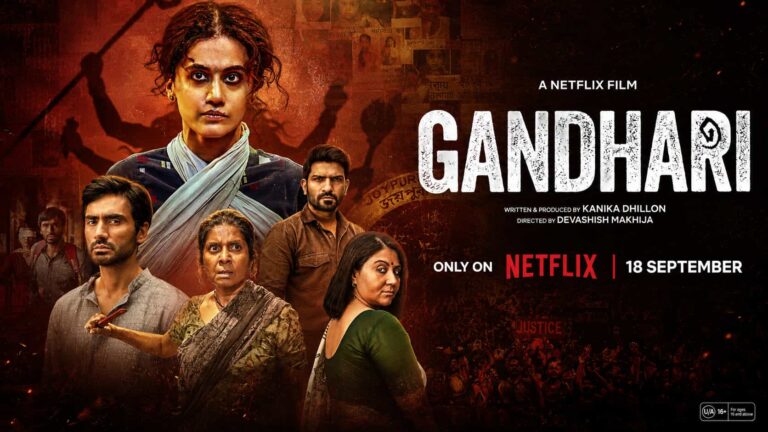
Gandhari is a Hindi action-thriller directed by Devashish Makhija and written by Kanika Dhillon. The film stars Taapsee Pannu, Ishwak Singh, Swastika Mukherjee, Mita Vashisth, Chhaya Kadam, Jatin Sarna and Prashant Narayanan.
The film began streaming on Netflix on September 3, 2026, with a runtime of approximately 2 hours 2 minutes.
The story follows a mother whose five-year-old daughter is abducted. Her desperate search takes her into a much larger child-trafficking network, and after she loses her eyesight, the rescue mission becomes an even more dangerous battle.
⭐ Quick Review Overview
| Category | Rating |
|---|---|
| Story | ⭐⭐⭐ |
| Screenplay | ⭐⭐½ |
| Direction | ⭐⭐⭐ |
| Performances | ⭐⭐⭐½ |
| Action | ⭐⭐⭐½ |
| Thriller | ⭐⭐⭐ |
| Emotional Impact | ⭐⭐½ |
| Cinematography | ⭐⭐⭐½ |
| Music & BGM | ⭐⭐⭐ |
| Editing | ⭐⭐⭐ |
| Climax | ⭐⭐½ |
| Overall | ⭐⭐½ / 5 |
📖 Storyline
Bani, played by Taapsee Pannu, is a mother living with her husband Gokul and their young daughter Mishty.
Everything changes when Mishty is abducted in broad daylight from the fictional town of Joypurra.
Bani is devastated and blames herself for what happened.
Together with Gokul, she begins searching for their daughter. What initially appears to be an isolated kidnapping gradually reveals something much darker—a larger child-trafficking operation operating within the town.
The investigation becomes increasingly dangerous.
And then comes the film’s biggest twist:
Bani loses her eyesight.
Now the mother who is already fighting against time must continue her search without being able to see.
That creates an interesting central question:
Can a mother find and rescue her child when she has lost one of her most important senses?
The basic premise is strong, but the film eventually introduces so many thriller elements that the emotional core becomes diluted.
👥 Cast & Performances
⭐ Taapsee Pannu as Bani
Taapsee is undoubtedly the film’s biggest asset.
Bani is required to go through fear, guilt, physical pain, anger and determination while also handling several demanding action sequences.
Taapsee handles the physical side convincingly.
Her transformation from an ordinary mother into a determined fighter is believable at several points.
However, the writing doesn’t always allow her to explore the emotional complexity of Bani.
Instead of allowing grief and fear to breathe, the screenplay frequently pushes her toward another action sequence or plot development.
That’s why the performance can feel more physically impressive than emotionally devastating. Both Times of India and Hindustan Times noted this gap between Taapsee’s physical commitment and the film’s emotional depth.
⭐ Performance: 3.5/5
⭐ Ishwak Singh as Gokul
Ishwak Singh plays Bani’s husband.
He provides the emotional counterbalance to Bani’s increasingly aggressive approach.
Unfortunately, his character is underwritten.
Considering that he is the father of the kidnapped child, the screenplay could have explored his emotional journey much more deeply.
⭐ Swastika Mukherjee
Swastika Mukherjee makes a particularly strong impression.
She plays a mysterious woman whose motives aren’t immediately clear.
Her quiet, unsettling presence creates some of the film’s most intriguing moments.
Interestingly, Times of India singled her out as one of the strongest performers in the film.
⭐ Performance: 3.5/5
⭐ Mita Vashisth
Mita Vashisth brings experience and gravitas to the ensemble.
Her presence adds weight to the thriller, although the character doesn’t receive enough development.
⭐ Chhaya Kadam
Chhaya Kadam delivers a dependable performance, but her role is surprisingly limited considering her ability.
⭐ Jatin Sarna
Jatin Sarna plays the police officer who arrives in Joypurra to investigate the case.
The police angle could have added another compelling layer to the story, but the screenplay doesn’t use it effectively.
🎬 Direction
Devashish Makhija approaches Gandhari as a gritty revenge-and-rescue thriller.
The fictional town of Joypurra is one of the film’s more interesting creations.
It’s portrayed as a strange, labyrinthine place filled with outsiders, hidden tunnels and people whose identities aren’t always what they initially appear to be.
That world-building gives the film an intriguing atmosphere.
Unfortunately, the direction becomes increasingly dependent on familiar thriller conventions.
The film repeatedly escalates:
Kidnapping → investigation → chase → fight → revelation → another twist → bigger fight
rather than allowing the characters and mystery to develop naturally.
Cinema Express and Times of India both criticised the film for relying too heavily on familiar thriller/action devices.
🔍 Mystery & Thriller
The central mystery is effective initially.
The audience wants to know:
- Who kidnapped Mishty?
- Why was she targeted?
- Who else is involved?
- What is happening in Joypurra?
- Can Bani find her daughter?
- What is the connection between the different characters?
The film has enough questions to keep the story moving.
The problem is that the answers aren’t always as satisfying as the questions.
Some twists feel designed simply to surprise the audience rather than emerging naturally from the story.
That reduces the suspense.
💥 Action
Action is one of the film’s stronger departments.
Taapsee’s physically demanding sequences are convincing, particularly once Bani’s character becomes more aggressive.
The film clearly wants to establish her as a formidable action protagonist.
However, some action sequences feel familiar.
The repeated situations where Bani appears cornered only to escape at the last moment reduce the suspense because the audience begins to recognise the pattern. Cinema Express specifically highlighted this repetition.
⭐ Action: 3.5/5
📷 Cinematography
The fictional world of Joypurra provides plenty of visual opportunities.
The film uses:
- Dark interiors
- Narrow spaces
- Underground passages
- Rural/small-town locations
- Night sequences
- Shadow-heavy compositions
These visuals help create a mysterious atmosphere.
However, one criticism is that the setting doesn’t always convincingly feel like West Bengal. Times of India felt that the film often looked more like it had been shot in Mumbai despite its Bengali setting.
⭐ Cinematography: 3.5/5
🎵 Music & Background Score
The background score works mainly to maintain urgency.
The film is constantly trying to create tension, so the music frequently pushes the action forward.
At times, however, the score feels like it is telling the audience to feel suspense rather than allowing the atmosphere itself to create suspense.
A little more restraint could have improved the thriller mood.
⭐ Music/BGM: 3/5
✂️ Editing & Screenplay
This is the film’s biggest weakness.
The basic story is actually straightforward:
A child disappears → parents search → trafficking network is discovered → mother fights to rescue her daughter.
But the screenplay keeps adding:
- Child trafficking
- Revenge
- Mystery
- A mysterious woman
- Police investigation
- Moral ambiguity
- Physical disability
- Action
- Multiple identities
- Elaborate twists
Instead of making the story richer, these elements sometimes compete with each other.
Times of India described the film as trying to incorporate too many thriller conventions, while Moneycontrol said the film begins strongly but loses its grip halfway through.
⚡ First Half vs Second Half
⭐ First Half — 3.5/5
The opening section is the film’s strongest portion.
The daughter’s kidnapping immediately creates emotional stakes.
The mysterious atmosphere of Joypurra also creates curiosity.
The audience wants to know what is happening and who is responsible.
The early mystery feels promising.
Verdict:
Gripping setup with a strong central premise.
⭐ Second Half — 2/5
Unfortunately, the second half loses much of the tension established earlier.
The film becomes increasingly action-heavy and starts relying on predictable thriller mechanics.
The emotional story of a mother desperately searching for her daughter gets pushed aside by the need to constantly escalate the plot.
The final confrontation also leans heavily into the kind of exaggerated action associated with older revenge dramas.
Verdict:
More action, but less emotional impact.
🧠 Critical Analysis
The title Gandhari carries obvious symbolic meaning.
Gandhari from the Mahabharata is famously associated with blindness, having chosen to blindfold herself.
The film uses this idea as a metaphor around blindness, motherhood, helplessness and rage.
Bani losing her eyesight could have been an extremely powerful narrative device.
The film could have explored:
What does it mean to lose sight but refuse to lose hope?
Instead, the disability becomes primarily another obstacle in the action-thriller machinery.
That’s the film’s biggest missed opportunity.
The story has the ingredients for a powerful examination of:
- Parental guilt
- Motherhood
- Female rage
- Child trafficking
- Helplessness
- Revenge
- Moral choices
But it doesn’t spend enough time developing those themes.
Times of India similarly argued that the potentially powerful story about parental guilt and female rage gets buried under the film’s constant escalation.
❤️ Emotional Impact
This is where Gandhari disappoints the most.
A five-year-old child is kidnapped.
That should automatically generate tremendous emotional anxiety.
Yet the film doesn’t always make the audience feel the parents’ desperation.
We understand that Bani wants her daughter back.
But understanding isn’t the same as emotionally experiencing it.
The screenplay moves so quickly between plot developments that the audience doesn’t get enough quiet moments with Bani and Mishty.
That makes the eventual rescue less powerful than it could have been.
🔥 What Works
✅ Taapsee Pannu’s physical performance
✅ Strong opening
✅ Interesting Joypurra setting
✅ Good mystery setup
✅ Several effective action sequences
✅ Swastika Mukherjee’s unsettling performance
✅ Ambitious themes
✅ Child-trafficking backdrop gives the story seriousness
✅ Compact 2-hour runtime
❌ What Doesn’t Work
❌ Too many thriller clichés
❌ Emotional connection is weaker than expected
❌ Character development is limited
❌ Ishwak Singh is underused
❌ Police subplot isn’t fully utilised
❌ Some twists feel forced
❌ Action becomes repetitive
❌ Second half loses momentum
❌ Bengali setting doesn’t always feel authentic
❌ Climax is overly theatrical
❌ The blindness angle isn’t explored deeply enough
🎯 Final Verdict — Is Gandhari Worth Watching?
Yes, but with moderate expectations.
Gandhari starts with a genuinely compelling idea: a mother searching for her kidnapped daughter in a mysterious town, only to lose her eyesight during the investigation.
That is enough material for an excellent psychological/action thriller.
Unfortunately, the movie tries to become too many things at once.
It wants to be a kidnapping mystery, revenge drama, child-trafficking thriller, female-led action film and psychological drama.
The result is entertaining in places but emotionally less powerful than its premise deserves.
Taapsee Pannu commits fully to the physical demands of the role, while Swastika Mukherjee provides one of the film’s most intriguing performances. But the screenplay repeatedly chooses spectacle over emotional depth.
⭐ Final Rating: 2.5/5
Verdict: ⭐⭐½☆☆
A promising mother-on-a-mission thriller with a strong opening and committed performance from Taapsee Pannu, but too many familiar twists, underdeveloped characters and an over-the-top second half prevent Gandhari from reaching its full potential.
📺 OTT
Netflix — Streaming from September 3, 2026.
Best reason to watch: Taapsee Pannu’s action performance + the intriguing first half.
Biggest drawback: The screenplay loses emotional focus.
Best suited for: Viewers who enjoy female-led Hindi action thrillers and kidnapping mysteries.