📥📥📥 800Mb
📥📥📥 3.5Gb
🎬 Movie Review: Arulvaan (2026) – A Sincere Social Drama About the Power of Education
⭐ Quick Review Overview
| Category | Details |
|---|---|
| Movie | Arulvaan |
| Release Date | 17 July 2026 |
| Language | Tamil |
| Genre | Drama / Family / Social |
| Director | Ganesh Vinayakan |
| Lead Actor | Arulnithi |
| Runtime | 1h 49m |
| Certification | U/A 7+ |
| Music | G. V. Prakash Kumar |
| Cinematography | M. Sukumar |
| Editor | Lawrence Kishore |
| Overall Rating | ⭐⭐⭐½☆ 3.5/5 |
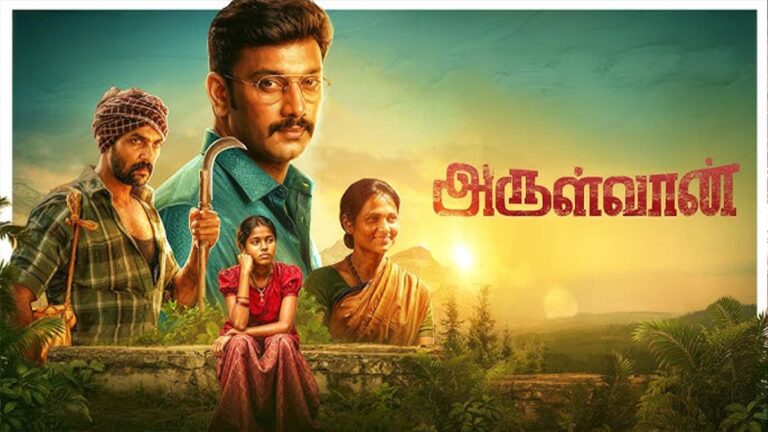
Arulvaan is a socially driven drama built around a simple but powerful idea: education should not be a privilege restricted by geography or social circumstances. The film follows a district collector who takes up the challenge of bringing education to an isolated tribal community after being moved by a young girl’s desire to study.
📖 Storyline & Narrative
The story revolves around Muthuvel, a determined district collector played by Arulnithi.
During his work, Muthuvel encounters a young tribal girl whose circumstances prevent her from receiving proper education. What initially appears to be an individual problem gradually becomes a much larger social issue.
The community lives in a remote forest region where access to basic facilities is difficult. Muthuvel decides that simply offering temporary assistance isn’t enough. He wants to establish a proper educational facility for the entire community.
However, his objective brings him into conflict with bureaucratic obstacles, local resistance and social circumstances.
The film’s central question is straightforward:
Should a child’s future depend on where that child happens to be born?
That question gives Arulvaan its emotional foundation.
🎭 Performances
⭐ Arulnithi – Muthuvel
Arulnithi delivers a restrained performance as the district collector.
Rather than turning Muthuvel into an exaggerated commercial hero, Arulnithi plays him as a relatively grounded government officer who believes strongly in his responsibility.
His controlled expressions and serious body language work particularly well during the film’s emotional confrontations.
The character doesn’t require excessive heroism—the conviction behind his actions does most of the work.
⭐ Ramya Pandian
Ramya Pandian brings warmth and naturalness to her role.
She fits comfortably into the rural environment and contributes to the film’s emotional atmosphere without trying to dominate the narrative.
⭐ Aarav
Aarav gets an important role within the story’s village-family setting and delivers a solid performance.
His presence becomes particularly effective when the film shifts toward the personal consequences of the community’s circumstances.
⭐ Baby Krithika
The young performer playing the tribal girl is one of the film’s emotional strengths.
The innocence and determination of the character provide the central emotional trigger for Muthuvel’s mission. Even reviews that were critical of the film’s filmmaking acknowledged the effectiveness of its central subject.
⭐ Supporting Cast
Kaali Venkat, John Vijay and VTV Ganesh provide useful supporting performances.
Kaali Venkat in particular brings some lighter moments as a reporter investigating the situation, while VTV Ganesh provides occasional comic relief.
🎬 Direction & Screenplay
Director Ganesh Vinayakan keeps the film focused on its social message rather than turning it into a conventional commercial entertainer.
The strongest aspect of the screenplay is its simplicity.
There isn’t an unnecessarily complicated plot. Instead, the movie concentrates on:
- Education
- Tribal communities
- Government responsibility
- Social inequality
- Bureaucratic obstacles
- Children’s aspirations
- The importance of accessibility
The film also benefits from its relatively short 109-minute runtime, which helps prevent the story from becoming excessively long.
However, the screenplay can occasionally feel too straightforward.
The film’s intention is so clear that some scenes feel designed primarily to communicate the message rather than naturally emerge from the characters.
This is where the film becomes somewhat one-dimensional, a criticism also raised by Cinema Express.
📷 Cinematography
M. Sukumar’s cinematography is one of the film’s visual strengths.
The forest and rural locations provide the movie with an authentic setting rather than making the environment feel like a conventional movie village.
The contrast between the isolated community and the administrative world surrounding Muthuvel visually reinforces the film’s central theme.
The natural locations also give the movie a grounded appearance.
🎵 Music & Background Score
Music is composed by G. V. Prakash Kumar, with lyrics/dialogues credited to Yugabharathi according to the listed production credits.
The music generally supports the emotional tone instead of overwhelming the story.
The background score works best during the scenes involving the tribal community and the girl’s struggle for education.
It isn’t necessarily a soundtrack-driven film, but the music helps maintain the emotional continuity.
✂️ Editing
Lawrence Kishore handles the editing.
The film’s biggest advantage here is its runtime.
At around 1 hour 49 minutes, Arulvaan doesn’t overstay its welcome.
That said, certain dramatic sequences could have benefited from more subtle editing instead of emphasizing the emotional beats so directly.
🧠 Critical Analysis
The most important thing about Arulvaan is that its message is stronger than its cinematic sophistication.
The movie wants the audience to think about an uncomfortable reality: children living in remote areas can be denied opportunities that urban children take for granted.
The story uses the district collector as the bridge between the government system and the community.
That makes Muthuvel less of a traditional hero and more of an institutional change-maker.
This is also why the movie feels relevant despite being set in a period before internet access became widespread. Times of India noted that the film’s argument for education continues to hold relevance today.
Where the film succeeds
The emotional foundation is sincere.
The film doesn’t try to make its social subject unnecessarily complicated. It asks viewers to care about a basic human right and the aspirations of a child.
Where it struggles
The filmmaking isn’t always sophisticated enough to match the seriousness of its subject.
Cinema Express was particularly critical, describing the film as stubbornly one-dimensional and arguing that the execution sometimes feels weaker than the issue it addresses.
Times of India, meanwhile, was more positive about the intent and performances, giving the film 3/5.
So the critical consensus is essentially:
Excellent social intention + sincere performances + straightforward execution.
⏱️ First Half vs Second Half
⭐ First Half – 3.5/5
The first half effectively establishes:
- Muthuvel’s character
- The tribal community
- The girl’s circumstances
- The education problem
- The central conflict
The emotional connection develops naturally, although some scenes lean heavily on sentiment.
⭐ Second Half – 3.5/5
The second half becomes more focused on Muthuvel’s efforts to overcome the obstacles standing between the community and education.
The emotional payoff works because the central objective has already been clearly established.
However, the conflict isn’t particularly unpredictable, and some scenes feel designed to reinforce the message rather than deepen the characters.
✅ What Works
- ⭐ Strong and relevant social message
- ⭐ Arulnithi’s restrained performance
- ⭐ Effective child performance
- ⭐ Natural rural/forest setting
- ⭐ Good supporting cast
- ⭐ Focused 109-minute runtime
- ⭐ Sincere emotional core
- ⭐ Education-focused storyline
- ⭐ G. V. Prakash Kumar’s supportive score
Audience reactions on BookMyShow were also broadly positive, with the platform showing strong user ratings and frequent tags such as #SuperDirection, #GreatActing, #AwesomeStory and #Inspiring.
❌ What Doesn’t Work
- ⚠️ Screenplay can feel one-dimensional
- ⚠️ Some emotional scenes are overly obvious
- ⚠️ Characters other than the central figures aren’t deeply developed
- ⚠️ Conflict is relatively predictable
- ⚠️ Social message occasionally takes priority over natural storytelling
- ⚠️ Some scenes feel more like a message delivery mechanism than organic drama
🏆 Final Verdict: Is Arulvaan Worth Watching?
Yes — especially if you enjoy meaningful Tamil social dramas.
Arulvaan isn’t a film that depends on twists, action or commercial heroism. Its strength lies in a simple human story about a child who wants an education and an officer who refuses to accept that geography should determine her future.
The filmmaking isn’t flawless, and the screenplay could have offered greater character depth and subtlety. But the film’s heart is in the right place, and Arulnithi’s grounded performance gives the story credibility.
If you are looking for a clean, family-friendly, socially conscious Tamil drama, Arulvaan is worth giving a chance.
⭐ Final Rating: 3.5/5
Story: ⭐⭐⭐⭐☆
Performances: ⭐⭐⭐⭐☆
Direction: ⭐⭐⭐½☆
Screenplay: ⭐⭐⭐☆☆
Cinematography: ⭐⭐⭐½☆
Music: ⭐⭐⭐½☆
Emotional Impact: ⭐⭐⭐⭐☆
Overall: ⭐⭐⭐½☆
🎯 Verdict:
A sincere and socially relevant drama whose message is more powerful than its filmmaking.