Movie Review: Toxic: A Fairy Tale for Grown-Ups (2026) – Yash Goes Dark in a Violent, Visually Ambitious Gangster Saga


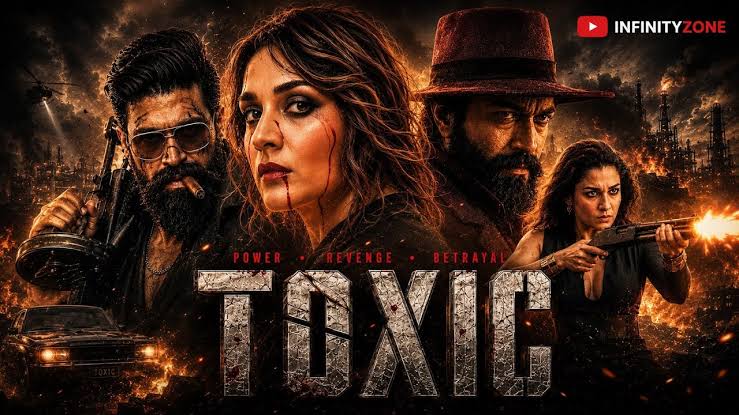
Toxic: A Fairy Tale for Grown-Ups is one of the most ambitious Indian gangster films of 2026. Directed by Geetu Mohandas, the film marks Yash’s return to the big screen after K.G.F: Chapter 2. Set against a period backdrop beginning in 1947 Goa and spanning roughly two decades, the movie follows the violent rise and complicated relationships of gangster Raya.
The film combines gangster drama, action, family conflict, drugs, violence and psychological themes. It features Yash in a dual role, alongside Nayanthara, Kiara Advani, Huma Qureshi, Tara Sutaria and Rukmini Vasanth.
Released theatrically on August 26, 2026, Toxic has generated strong audience interest but also mixed early reviews. Critics have praised its visuals, action design and Yash’s performance while questioning the screenplay, emotional depth and lengthy runtime. (India Today)
Quick Review Overview
| Attribute | Details |
|---|---|
| Director | Geetu Mohandas |
| Writers | Geetu Mohandas, Deepak Venkateshan |
| Lead Cast | Yash, Nayanthara, Kiara Advani |
| Supporting Cast | Huma Qureshi, Tara Sutaria, Rukmini Vasanth |
| Genre | Gangster Drama / Action / Crime Thriller |
| Release Date | August 26, 2026 |
| Language | Kannada, Tamil, Telugu, Hindi, Malayalam |
| Certification | A |
| Runtime | Over 3 Hours |
| Production | KVN Productions |
| Director of Photography | Jomon T. John |
| Music | Charan Raj |
| Editor | Sreekar Prasad |
The film was released across multiple Indian languages and received an A certificate, with the Hindi version receiving additional cuts for abusive dialogue and a drug-related sequence. (The Times of India)
Storyline: A Fairy Tale Filled with Blood and Betrayal
Toxic opens in Goa in 1947, introducing the audience to a world where organised crime, drugs, money and political influence are beginning to intertwine.
At the centre of this world is Raya, played by Yash.
Raya is ambitious, ruthless and intelligent. He understands that power isn’t simply about physical strength—it is about controlling people, money and fear.
As the years pass, Raya’s criminal empire grows.
But his greatest problems don’t necessarily come from rival gangsters.
They come from his own family and relationships.
The film gradually explores Raya’s complicated relationship with his son Ticket, also played by Yash, alongside his relationships with the women around him.
The story moves between crime, family trauma, ambition and betrayal as Raya’s empire becomes increasingly unstable.
Rather than presenting a conventional hero-versus-villain gangster story, Toxic attempts to examine how power changes a person and how toxic relationships can influence generations.
The film ultimately builds toward a violent confrontation between Raya and Ticket, with the climax introducing an unexpected psychological twist that deliberately leaves certain aspects of the story open to interpretation. (The Economic Times)
Character Performances: Yash Dominates the Screen
Yash as Raya / Ticket
There is no question that Toxic belongs to Yash.
Playing dual roles gives him the opportunity to portray two very different sides of the story.
As Raya, Yash creates an intimidating gangster who carries himself with tremendous confidence.
The character is violent and morally complicated, but Yash gives him a commanding screen presence.
His appearance, body language and dialogue delivery are clearly designed for the big screen.
The mass moments work because Yash understands exactly how much physical presence is required.
As Ticket
His second character, Ticket, provides a contrasting emotional dimension.
The relationship between father and son becomes increasingly important as the story progresses.
The dual-role performance is one of the film’s major attractions and demonstrates Yash’s ability to separate the two characters through mannerisms and emotional expression.
Even critics who disliked portions of the screenplay have generally acknowledged Yash’s commitment and screen presence. (India Today)
Nayanthara
Nayanthara brings considerable maturity to the film.
Her character is connected closely to the family and emotional side of Raya’s story.
Rather than simply functioning as a conventional romantic heroine, Nayanthara provides some of the film’s more serious emotional moments.
Her screen presence is one of the positives repeatedly highlighted in early audience reactions. (Asianet News Tamil)
Kiara Advani
Kiara Advani plays another important character within Raya’s world.
She gets several stylish sequences and contributes to the film’s glamorous presentation.
However, the character is less fully developed than the central male characters.
Some critics have specifically argued that the female characters are underwritten and that the screenplay does not give them enough independent emotional depth. (India Today)
Huma Qureshi
Huma Qureshi adds another strong performer to the ensemble.
Her character belongs to the dangerous world surrounding Raya and helps expand the criminal network beyond the central family.
She brings the intensity expected from a gangster drama.
Tara Sutaria
Tara Sutaria adds another layer to the film’s large ensemble.
Her character is connected to the criminal world and contributes to the film’s glamorous but dangerous atmosphere.
Rukmini Vasanth
Rukmini Vasanth is another important member of the cast.
Her presence adds emotional weight to the family narrative and helps strengthen the film’s generational themes.
Technical Craft & Direction: A Massive Visual Canvas
This is where Toxic makes its strongest impression.
Director Geetu Mohandas has created a film that is visually far removed from a conventional commercial gangster movie.
The production design, period setting, costumes, lighting and action choreography create a highly stylised world.
Even reviewers who criticised the screenplay have acknowledged the film’s technical ambition. (Indian Express – Bangla)
Cinematography
The cinematography is one of the film’s biggest strengths.
The period Goa setting is presented with a dark, atmospheric visual palette.
Large-scale sets and carefully designed interiors give the film a cinematic grandeur.
The camera frequently turns violence into spectacle, creating striking compositions during the action sequences.
The visual language is clearly influenced by international gangster cinema while retaining a distinctly Indian commercial scale.
Action Sequences
The action is arguably the film’s biggest crowd-pleaser.
Toxic features:
- Gun battles
- Hand-to-hand combat
- Brutal killings
- Gang warfare
- Large-scale confrontations
- Stylised mass sequences
The violence is extremely graphic, which is one reason the film received an A certificate.
Early audience reactions have particularly praised the action choreography and Yash’s mass moments. (Navbharat Times)
Music & Background Score
Charan Raj provides the music.
The background score plays an important role in establishing the film’s dark gangster atmosphere.
The music works especially well during Yash’s elevation scenes and action sequences.
However, the film’s visual spectacle sometimes becomes more memorable than the songs themselves.
Editing
Sreekar Prasad handles the editing.
This is one of the more controversial technical aspects of the film.
At over three hours, Toxic is a demanding watch.
Some reviewers have criticised the film for feeling overlong and narratively confusing, particularly during portions of the first half. (Indian Express – Malayalam)
A tighter edit could potentially have improved the pacing considerably.
Critical Analysis: Style vs Substance
The central question surrounding Toxic is simple:
Does the film’s style overpower its story?
The answer is partly yes.
Geetu Mohandas has created a visually ambitious gangster world.
The film looks expensive.
The action is bold.
Yash’s performances are committed.
The production design is impressive.
But the emotional writing doesn’t always match the scale of the presentation.
The story attempts to explore:
Power → Addiction → Family → Masculinity → Violence → Generational Trauma
These are potentially powerful themes.
But the screenplay sometimes jumps between them too quickly.
The result is a film that can feel spectacular without always being emotionally satisfying.
India Today described the movie as a case of “style over substance,” praising the performances, visuals and action while criticising the tonal confusion and underwritten women. (India Today)
The Indian Express similarly praised the large visual canvas but felt the film’s violence and style overshadowed its emotional core. (Indian Express – Bangla)
At the same time, Tamil reviews have been more appreciative of the gangster-world construction, Yash’s dual performance and the psychological relationships within the story. (Maalai Malar)
So the film is likely to be highly divisive.
What Works
✅ Yash’s Dual Performance
The biggest reason to watch the film.
✅ Powerful Screen Presence
Yash’s introduction and elevation scenes are designed for the theatrical experience.
✅ Stunning Visuals
The period setting and production design create a large cinematic world.
✅ Action
Brutal, stylish and technically impressive.
✅ Nayanthara
Brings maturity and emotional weight to the ensemble.
✅ Ambitious Direction
Geetu Mohandas attempts something considerably different from a standard commercial gangster film.
✅ Dark Atmosphere
The film maintains a distinctive, grim visual identity.
What Doesn’t Work
❌ Very Long Runtime
The film can feel exhausting because of its three-plus-hour duration.
❌ Uneven Screenplay
The story becomes difficult to follow in places.
❌ Limited Emotional Depth
The film’s emotional ambitions aren’t always matched by its writing.
❌ Underwritten Female Characters
Several important women are primarily defined through their relationships with male characters. (India Today)
❌ KGF Comparisons
Some viewers may feel that the mass presentation and gangster imagery occasionally echo Yash’s KGF persona.
❌ Excessive Violence
The brutality can become overwhelming, especially for viewers looking for a more character-driven gangster drama.
Final Verdict: Is It Worth Watching?
Toxic: A Fairy Tale for Grown-Ups is a visually extravagant, brutally violent and ambitious gangster drama that is carried largely by Yash’s performance and Geetu Mohandas’ distinctive visual direction.
Yash is undoubtedly the film’s biggest strength. His dual-role performance gives the story a strong central presence, while Nayanthara, Kiara Advani, Huma Qureshi, Tara Sutaria and Rukmini Vasanth add considerable star power to the ensemble.
The film’s action, cinematography, production design and atmosphere are impressive.
But the screenplay is less consistent.
The lengthy runtime, uneven pacing and limited emotional development prevent Toxic from reaching the level of its enormous visual ambition.
Ultimately, this is a film that works best on the big screen, particularly for viewers who enjoy large-scale gangster stories, stylised violence and Yash’s mass performances.
If you’re expecting another KGF, however, Toxic is a very different experience. It is darker, stranger and more psychologically focused, even though some of its presentation may remind viewers of Yash’s previous gangster image.
Recommended for: Yash fans, gangster-film lovers, action enthusiasts and viewers who enjoy visually ambitious cinema.
Not recommended if: You prefer tightly written stories, shorter runtimes or emotionally grounded dramas.
Overall Rating: ⭐⭐⭐½ / 5 (India Today)