Download 900Mb
Download 3.3Gb
Movie Review: Newton’s 3rd Law (2026) – A Patient Crime Thriller Where Every Action Has a Reaction
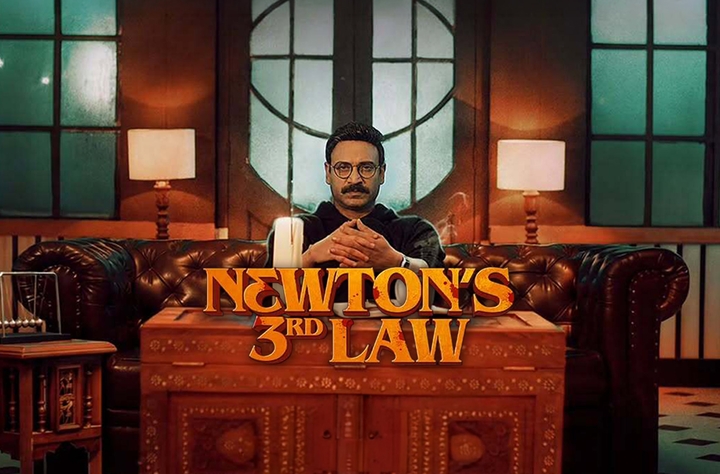
Newton’s 3rd Law is a Telugu mystery crime thriller directed by debutant Rajesh Karna, starring Sumanth Yarlagadda in the lead role alongside Jagapathi Babu, Srinivas Avasarala, Trinadh Varma, Ravi Varma and Neha Pathan.
Set largely against a 1999 Hyderabad backdrop, the film uses Newton’s famous principle—“for every action, there is an equal and opposite reaction”—as the foundation for a story involving murder, family secrets, crime and karma. (TrackTollywood)
The film was released theatrically on July 31, 2026, with a UA 16+ certificate and a certified length of 138 minutes. It subsequently became available digitally on ETV Win from August 27, 2026. (CBFC India)
Quick Review Overview
| Attribute | Details |
|---|---|
| Director | Rajesh Karna |
| Writer | Rajesh Karna |
| Lead Cast | Sumanth Yarlagadda, Jagapathi Babu |
| Supporting Cast | Srinivas Avasarala, Trinadh Varma, Ravi Varma, Neha Pathan, Shelly N Kumar, Abhinayanaa Reddy, Goutham Pandit |
| Music Composer | Sinjith Yerramilli |
| Cinematography | Veda Vyas Gottipati |
| Editor | Anil Pasala |
| Genre | Crime Thriller / Mystery / Drama |
| Language | Telugu |
| Runtime | 138 Minutes |
| Certification | UA 16+ |
| Theatrical Release | July 31, 2026 |
| Digital Release | August 27, 2026 on ETV Win |
| Producer | Harish Kohirkar |
| Production | Mark My Words Entertainment |
The official CBFC record confirms the Telugu language, UA 16+ certification, 138-minute length, producer Harish Kohirkar, director Rajesh Karna, cinematographer Veda Vyas Gottipati and editor Anil Pasala. (CBFC India)
Storyline: A Murder Investigation Connected to a Much Bigger Secret
The story is set in Hyderabad in 1999.
At the centre of the narrative is Vasudev, played by Sumanth Yarlagadda, a police officer who becomes involved in investigating the suspicious death of a young man named Vinay, played by Trinadh Varma.
What initially appears to be a suicide or accidental death gradually begins to look like something much darker.
As Vasudev investigates, he discovers inconsistencies surrounding Vinay’s death.
The investigation leads him toward a dangerous criminal named Stephen Mercury, played by Jagapathi Babu.
But the deeper Vasudev goes, the more complicated the case becomes.
Family relationships, hidden motives, old crimes and unexpected connections begin coming together.
Another important element involves David, played by Srinivas Avasarala, who receives a mysterious book titled Newton’s 3rd Law. The book appears to describe events connected to the case, creating another layer of mystery around the investigation. (TeluguOne)
The film’s central idea is straightforward:
Every action has a consequence.
Someone’s decision in the past eventually creates a reaction years later.
And as Vasudev pieces together the truth, the audience is encouraged to reconsider who is actually responsible for the tragedy.
Character Performances: Sumanth Keeps It Controlled
Sumanth Yarlagadda as Vasudev
Sumanth Yarlagadda is the film’s biggest strength.
As Vasudev, he plays a police officer who approaches the investigation with patience rather than unnecessary heroics.
This is important because Newton’s 3rd Law isn’t designed as a conventional police action movie.
Vasudev spends much of the film:
- Observing
- Questioning suspects
- Connecting clues
- Revisiting evidence
- Understanding people’s motives
Sumanth’s restrained performance fits that approach.
He doesn’t need exaggerated dialogue or mass action sequences to establish authority.
His performance is particularly effective during the investigative portions and the climax.
Several reviews and audience reactions have praised his controlled performance. (All Tenvow)
Jagapathi Babu as Stephen Mercury
Jagapathi Babu brings considerable weight to the film as Stephen Mercury.
The character is connected to the criminal world and becomes increasingly important as Vasudev’s investigation develops.
Jagapathi Babu’s calm screen presence makes the character dangerous without requiring constant physical violence.
His experience in playing morally grey characters works strongly in his favour here.
Whenever he appears, there is a sense that the character knows more than he is willing to reveal.
That mystery makes Stephen Mercury one of the more interesting characters in the film.
Srinivas Avasarala as David
Srinivas Avasarala plays David, whose connection to the mysterious book becomes an important part of the narrative.
Avasarala brings an understated quality to the character.
His scenes help establish the film’s more philosophical side, particularly the connection between Newton’s law and the concept of karma.
Trinadh Varma as Vinay
Trinadh Varma plays Vinay, whose death becomes the catalyst for the entire investigation.
Although the character is not present throughout the film in the traditional sense, his story remains central to the mystery.
His performance helps establish the emotional stakes behind the investigation.
Ravi Varma
Ravi Varma plays an important supporting role in the investigative narrative.
He contributes to the film’s grounded police-and-crime atmosphere.
Neha Pathan
Neha Pathan is another important member of the ensemble.
Her character becomes connected to the mystery and family elements surrounding the case.
She provides additional emotional dimension to an otherwise investigation-heavy narrative.
Shelly N Kumar, Abhinayanaa Reddy & Goutham Pandit
The supporting cast also includes Shelly N Kumar, Abhinayanaa Reddy and Goutham Pandit.
They help populate the film’s network of suspects and characters.
The ensemble approach works because the screenplay deliberately keeps the audience questioning who is telling the complete truth.
The principal cast is listed by BookMyShow and the official CBFC record. (BookMyShow)
Technical Craft & Direction: Atmosphere Over Spectacle
Director Rajesh Karna takes a relatively restrained approach for his debut.
Rather than filling the movie with unnecessary action, he concentrates on mystery, investigation and character motivations.
That decision gives Newton’s 3rd Law a different identity from mainstream Telugu crime entertainers.
The director clearly wants the audience to pay attention to clues and relationships.
The film’s strongest moments come when it trusts the mystery rather than trying to manufacture excitement through spectacle.
Cinematography
Veda Vyas Gottipati handles the cinematography.
The visuals establish a suitably dark and atmospheric crime-thriller world.
The 1999 setting is particularly useful because the story doesn’t depend on modern technology to solve its mystery.
Police investigations, physical evidence and human observation remain important.
The cinematography also contributes to the film’s slow-burn quality.
Audience reactions have specifically praised the film’s technical execution and cinematography. (The Times of India)
Music & Background Score
Sinjith Yerramilli provides the music.
The background score is particularly important because the movie spends substantial time building suspense.
Instead of dominating scenes, the score works underneath the investigation and gradually increases tension.
Reviews have highlighted the background score as one of the film’s positives. (All Tenvow)
Editing
Anil Pasala handles the editing.
This is arguably the department that could have been stronger.
The film is officially 138 minutes, which is reasonable for a mystery thriller, but portions of the investigation move slowly.
The first half spends considerable time establishing characters and clues.
For viewers who enjoy slow-burn mysteries, this patience may be rewarding.
For viewers expecting constant twists, it can feel somewhat repetitive.
One review specifically described the first half as slow and occasionally repetitive, while still praising the eventual payoff. (All Tenvow)
Critical Analysis: Action and Reaction
The smartest aspect of Newton’s 3rd Law is the way it connects the scientific principle to human behaviour.
Newton’s third law says:
For every action, there is an equal and opposite reaction.
The film applies that idea to crime and morality.
A decision made years ago can create consequences much later.
A lie creates another lie.
A crime creates another crime.
A betrayal creates revenge.
And an attempt to hide the truth eventually produces another reaction.
This makes the title more than just a stylish name.
The film uses it as a thematic framework.
The mystery is therefore not simply:
“Who committed the crime?”
It also asks:
“Why did the crime happen?”
And:
“What chain of actions created the situation?”
That philosophical layer gives the film more substance than a standard murder investigation.
The Climax: The Film’s Biggest Strength
The final stretch is where Newton’s 3rd Law earns much of its value.
The movie patiently establishes its characters and clues before bringing several pieces together.
The climax has been widely praised by audiences, with social-media reactions particularly highlighting the twists and final revelations. (The Times of India)
A review from Tenvow similarly praised the memorable climax and clever twists, while noting that the first half demands patience. (All Tenvow)
The payoff won’t necessarily work for everyone, but the film clearly saves some of its strongest material for the final act.
What Works
✅ Sumanth’s Performance
Controlled, mature and perfectly suited to the investigative role.
✅ Jagapathi Babu
Brings gravitas and menace to Stephen Mercury.
✅ Strong Central Concept
The connection between Newton’s law and karma gives the thriller an interesting thematic foundation.
✅ Mystery & Twists
The investigation keeps the audience guessing.
✅ Climax
The strongest portion of the film and one of its biggest selling points.
✅ Cinematography
Creates an atmospheric crime-thriller world.
✅ Background Score
Adds tension without overwhelming the narrative.
✅ 1999 Setting
The period backdrop gives the investigation a distinctive identity.
What Doesn’t Work
❌ Slow First Half
The movie takes considerable time to establish its characters and mystery.
❌ Repetitive Investigation
Some investigative sequences could have been shortened.
❌ Uneven Pacing
The narrative occasionally loses momentum before the major revelations.
❌ Limited Mass Moments
Viewers expecting a conventional Sumanth action film may find it restrained.
❌ Some Predictability
Not every twist is equally surprising.
❌ Emotional Depth
The central mystery is stronger than some of the character relationships surrounding it.
Final Verdict: Is It Worth Watching?
Newton’s 3rd Law is a patient, atmospheric Telugu crime thriller that rewards viewers who are willing to wait for its mystery to unfold.
Sumanth delivers a convincing performance as the calm and determined investigator, while Jagapathi Babu adds considerable weight to the criminal side of the story. Srinivas Avasarala, Trinadh Varma, Ravi Varma and Neha Pathan provide solid support.
The film’s biggest strengths are its concept, investigation, performances, cinematography, background score and climax.
Its main weakness is pacing.
The first half could have been tighter, and some investigative scenes repeat information that could have been communicated more efficiently.
But the film’s underlying idea is interesting, and the climax gives the story a satisfying payoff.
If you enjoy slow-burn crime thrillers, murder mysteries, investigative dramas, psychological twists and films where seemingly unrelated events eventually connect, Newton’s 3rd Law is worth watching.
It is less suited to viewers looking for nonstop action or conventional commercial entertainment.
With its ETV Win digital release from August 27, 2026, it is now an easy option for a weekend mystery-thriller watch. (Letterboxd)
Overall Rating: ⭐⭐⭐½ / 5