📥📥📥 1.4Gb
📥📥📥 2.4Gb
🎬 Movie Review: The Yellow Elephant (2026) – A Moving Story of an Elephant, a Mahout and the Human–Wildlife Conflict
⭐ Quick Review Overview
| Category | Details |
|---|---|
| Movie | The Yellow Elephant |
| Release Year | 2026 |
| Language | Tamil |
| Genre | Documentary / Social Drama |
| Director | Baskar Arumugam |
| Lead Performers | Sendrayan, Rams, Gokul Boopalan, Smruthi |
| Central Subject | Raju, a working elephant, and his mahout Chengu |
| Runtime | Approx. 1h 12m |
| OTT | aha |
| Overall Rating | ⭐⭐⭐⭐☆ 4/5 |
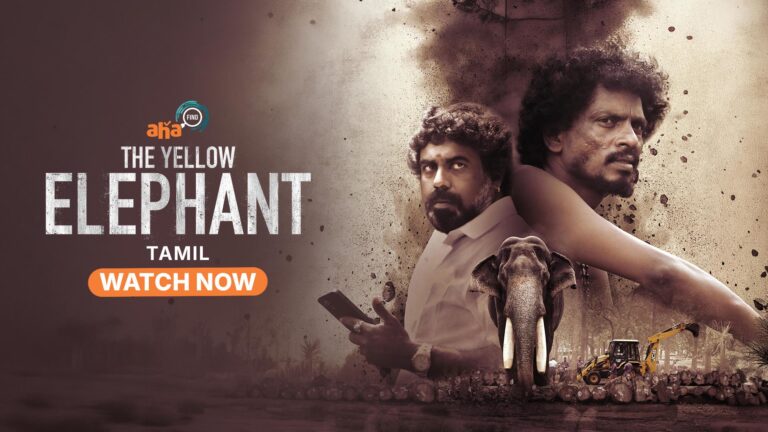
The Yellow Elephant is not a conventional commercial film. It is a compact, socially conscious documentary-style drama built around Raju, an elephant working at a timber yard, and Chengu, the mahout who has developed a close bond with him.
The film explores an uncomfortable question:
When human livelihood and animal welfare collide, who gets to decide what happens to the animal?
That gives the movie considerably more emotional weight than its simple premise initially suggests.
📖 Storyline & Narrative
The story is set against the backdrop of forest areas in southern Tamil Nadu.
Wild animals such as deer and wild boars are hunted using locally made explosive devices, while trees are also cut in the forest with government permission.
At the centre of this environment is Raju, an elephant used at Shanmugam’s timber yard to load and transport cut trees.
Raju’s mahout, Chengu, works closely with him and takes responsibility for his care.
Their relationship is important because Raju isn’t portrayed merely as a working animal.
He is an intelligent living creature with whom Chengu has developed a deep bond.
Everything changes when wildlife activists secretly film Raju working at the timber yard and submit the footage to the authorities.
Shanmugam suddenly finds himself under pressure.
His solution?
Send Raju away.
From this point, the film follows what happens to Raju and Chengu and how the decision changes both their lives.
🐘 Raju – The Real Protagonist
The biggest strength of The Yellow Elephant is that the elephant itself becomes the emotional centre of the film.
There is no traditional hero-versus-villain structure.
Instead, the audience is encouraged to observe the situation from different perspectives.
Shanmugam
For him, Raju is part of a working operation.
Chengu
For him, Raju is a companion and responsibility.
Wildlife activists
For them, Raju represents an animal whose welfare must be protected.
Raju
He has no voice in any of these decisions.
And that’s what makes the story powerful.
The film effectively asks whether humans should be making life-changing decisions about animals without considering the emotional and biological consequences for them.
🎭 Performances
⭐ Sendrayan
Sendrayan brings a grounded quality to the film.
His performance fits the rural environment naturally, and he avoids unnecessary theatricality.
In a film where the central emotional relationship is between a human and an elephant, the human characters need to feel believable.
Sendrayan helps achieve that authenticity.
⭐ Rams
Rams contributes to the film’s grounded ensemble.
The performances don’t feel like conventional commercial-movie performances.
That suits the documentary-inspired tone.
⭐ Gokul Boopalan
Gokul Boopalan adds another dimension to the human side of the narrative.
The supporting performances help establish the social environment surrounding Raju.
⭐ Smruthi
Smruthi is also part of the principal cast.
The ensemble collectively gives the film a realistic rural texture rather than turning the story into a conventional star vehicle.
🎬 Direction & Screenplay
Baskar Arumugam
Director Baskar Arumugam keeps the film relatively compact and focused.
Rather than trying to create a large-scale animal adventure, the film concentrates on a specific human–elephant relationship and the circumstances that threaten it.
That is a smart decision.
The film’s award recognition also supports the strength of its central subject: at the Indian Panorama International Film Festival, The Yellow Elephant received Best Narrative on Human vs Nature Conflict.
The screenplay’s greatest strength is its simplicity.
There is no need for a complicated plot.
The conflict is already powerful:
A working elephant → an activist intervention → government pressure → separation → consequences.
🌳 Human vs Nature
This is the central theme of the movie.
The film doesn’t simply say:
“Humans are bad and animals are good.”
The situation is more complicated.
People depend on forests for their livelihoods.
Timber work creates employment.
Mahouts depend on elephants for their work.
Wildlife activists want animals protected.
Government departments have their own rules.
And somewhere in the middle is the elephant.
That complexity gives the film more maturity.
❤️ Chengu & Raju
The relationship between Chengu and Raju is the emotional heart of the film.
Chengu isn’t simply an elephant handler.
His relationship with Raju is based on familiarity, trust and responsibility.
When Raju’s future becomes uncertain, the emotional consequences extend to Chengu as well.
The movie therefore works on two levels:
🐘 Animal welfare
What happens to Raju?
👨 Human livelihood
What happens to Chengu when the animal he works with and cares for is taken away?
That connection gives the film its emotional depth.
📷 Cinematography
The forest environment is naturally one of the film’s biggest visual assets.
Instead of relying entirely on artificial sets, the story benefits from the atmosphere of southern Tamil Nadu’s forest regions.
The natural environment reinforces the central theme.
The forest isn’t simply a background.
It is part of the conflict.
🎵 Music & Sound
Because this is a documentary-style narrative, the sound design and atmosphere are more important than having a conventional commercial soundtrack.
The sounds of:
- Forests
- Animals
- Machinery
- Timber work
- Human activity
help create the sense of a living environment.
This restrained approach suits the film better than an overly dramatic score would.
✂️ Editing
At around 72 minutes, The Yellow Elephant is considerably shorter than a conventional feature film.
That works in its favour.
The film has a specific story to tell and doesn’t unnecessarily stretch it.
The compact runtime also makes the emotional conflict more concentrated.
There is little room for unnecessary subplots.
🧠 Critical Analysis
The strongest aspect of The Yellow Elephant is its ability to turn a seemingly small incident into a larger discussion about humanity’s relationship with nature.
At first, the problem seems simple:
An elephant is being used to move timber.
But then several questions emerge.
Is the elephant being exploited?
Is the mahout also dependent on the elephant?
Can an animal that has spent years with humans simply be relocated?
What happens when conservation rules collide with traditional livelihoods?
And most importantly:
Does protecting an animal always mean simply removing it from the human environment?
The film doesn’t need to answer every question.
Its purpose is to make us think about them.
⏱️ First Half vs Second Half
⭐ First Half – 4/5
The first half establishes:
- The forest environment
- Shanmugam’s timber operation
- Raju
- Chengu
- Their relationship
- The arrival of wildlife activists
The setup is straightforward but effective.
The emotional connection develops gradually.
⭐ Second Half – 4/5
The second half becomes more emotionally focused.
Once Shanmugam decides to send Raju away, the story becomes less about the timber yard and more about the consequences of that decision.
The film’s strength here is its restraint.
It doesn’t need excessive melodrama to make the situation affecting.
🌿 What Works
- ⭐ Strong human–animal theme
- ⭐ Raju is an emotionally effective central subject
- ⭐ Chengu–Raju relationship
- ⭐ Authentic rural/forest atmosphere
- ⭐ Socially relevant subject
- ⭐ Compact runtime
- ⭐ Grounded performances
- ⭐ Avoids unnecessary commercial elements
- ⭐ Raises meaningful ethical questions
- ⭐ Strong human-vs-nature conflict
- ⭐ Award recognition for its central theme
❌ What Doesn’t Work
- ⚠️ Not a conventional commercial entertainer
- ⚠️ Limited character development compared with a feature-length drama
- ⚠️ Some viewers may find the documentary-style pacing slow
- ⚠️ The narrative leaves several larger environmental questions unexplored
- ⚠️ Those expecting a conventional elephant adventure may be disappointed
🏆 Final Verdict: Is The Yellow Elephant Worth Watching?
Yes — especially if you enjoy meaningful Tamil cinema and wildlife-related stories.
The Yellow Elephant is not trying to give the audience a mass hero, comedy track or conventional commercial climax.
Instead, it tells a smaller and more human story about an elephant, the man who cares for it, and a system that suddenly decides their relationship cannot continue.
Its greatest strength is its emotional simplicity.
You don’t need complicated twists to care about Raju.
You simply need to understand that an animal can form bonds with people—and that separating them can have consequences for both.
At only around 72 minutes, the film also respects the audience’s time.
⭐ Final Rating: 4/5
Story: ⭐⭐⭐⭐☆
Performances: ⭐⭐⭐½☆
Direction: ⭐⭐⭐⭐☆
Screenplay: ⭐⭐⭐⭐☆
Cinematography: ⭐⭐⭐⭐☆
Sound/Music: ⭐⭐⭐½☆
Editing: ⭐⭐⭐⭐☆
Emotional Impact: ⭐⭐⭐⭐½
Social Relevance: ⭐⭐⭐⭐⭐
Overall: ⭐⭐⭐⭐☆
🎯 Final Verdict
A heartfelt and socially relevant Tamil documentary-drama that uses the bond between an elephant and its mahout to explore the difficult relationship between humans, animals and the forest. Quiet, emotional and thought-provoking rather than commercial.