📥📥📥 900Mb
📥📥📥 2.5Gb
Movie Review: Sardar 2 (2026) – Bigger Espionage, Bigger Scale, But an Uneven Sequel
Overview
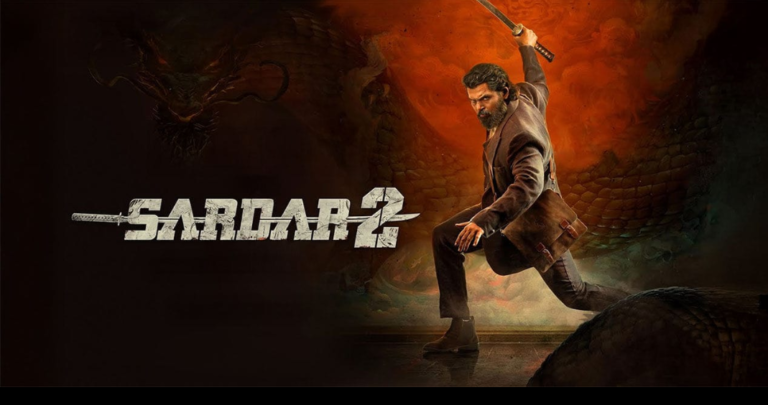
Sardar 2 is a Tamil spy-action thriller directed by P. S. Mithran, returning to the world created in the 2022 film Sardar. Karthi once again appears in dual roles as veteran RAW operative Chandra Bose, aka Sardar, and his son Vijay Prakash. The sequel also features S. J. Suryah, Malavika Mohanan, Ashika Ranganath, Rajisha Vijayan and Yogi Babu.
The film was released theatrically on September 10, 2026, and has a runtime of approximately 2 hours 59 minutes.
The sequel expands the franchise from a relatively grounded spy thriller into a much larger international action spectacle. Its central conflict revolves around a dangerous biochemical weapon, a criminal organisation and a mission that once again connects Sardar’s past with Vijay Prakash’s present.
The ambition is obvious, but the larger scale doesn’t always translate into stronger storytelling.
Quick Review Overview
| Category | Review |
|---|---|
| Genre | Spy / Action / Thriller |
| Language | Tamil |
| Director | P. S. Mithran |
| Lead | Karthi |
| Release Date | September 10, 2026 |
| Runtime | Approx. 2h 59m |
| Music | Sam C.S. |
| Cinematography | George C. Williams |
| Editing | Vijay Velukutty |
| Major Antagonist | S. J. Suryah |
| Biggest Strength | Karthi’s dual-role performance |
| Biggest Weakness | Screenplay and lengthy second half |
| Overall Rating | ⭐⭐⭐/5 |
Storyline
After the events of the first Sardar, Vijay Prakash has joined RAW but struggles to escape the shadow of his father.
Sardar, meanwhile, remains connected to a painful chapter from his past.
The new mission revolves around Doku, a dangerous biochemical weapon capable of causing mass casualties. Three operatives have hidden the weapon, with separate keys required to access it.
The villain Black Dagger, played by S. J. Suryah, is determined to obtain it.
Vijay is assigned to the mission, but the investigation eventually pulls Sardar’s past back into the present.
A previous operation involving Sardar, Japan and an attempt to obtain an antidote becomes an important part of the larger mystery.
The film therefore works across multiple locations and timelines while building toward the confrontation between Sardar, Vijay and Black Dagger.
Performances
Karthi – Sardar / Vijay Prakash
Karthi remains the biggest strength of Sardar 2.
The challenge of playing two characters is handled with noticeable differences in body language, temperament and screen presence.
As Sardar, Karthi brings maturity and controlled intensity. The character carries the weight of his past and has a quieter authority.
As Vijay Prakash, he is comparatively emotional and vulnerable.
The father-son relationship remains one of the more effective emotional elements of the sequel. Multiple reviews have specifically highlighted Karthi’s performance as a major positive.
S. J. Suryah – Black Dagger
S. J. Suryah brings his trademark intensity to Black Dagger.
His introduction gives the film immediate energy, and his expressive style makes him an entertaining screen presence.
However, the character’s writing isn’t strong enough to sustain that impact throughout the nearly three-hour runtime.
Several reviews make a similar point: Suryah performs with energy, but the villain is not developed deeply enough.
Malavika Mohanan
Malavika Mohanan makes a strong impression whenever she appears.
Her action-oriented portions are handled confidently, and she has good screen presence opposite Karthi.
The major limitation is the writing. Her character doesn’t receive enough independent development, making her more functional to the plot than fully integrated into the emotional story.
Ashika Ranganath
Ashika Ranganath contributes to the supporting cast, though the spy-thriller plot leaves limited space for deeper character development.
Rajisha Vijayan
Rajisha Vijayan returns from the first film.
Her presence helps maintain continuity with the original, but the sequel doesn’t give her as much dramatic material as one might expect from the franchise’s returning characters.
Technical Analysis
Direction – P. S. Mithran
P. S. Mithran clearly wants Sardar 2 to be much bigger than its predecessor.
The film expands the spy world, increases the action scale and introduces a more dangerous global threat.
The ambition is commendable.
The problem is that the screenplay doesn’t always control that ambition.
Some twists feel difficult to accept, and the film occasionally explains its ideas rather than allowing the story to communicate them naturally. The Indian Express particularly criticised the screenplay, CGI and overlong runtime.
Cinematography – George C. Williams
George C. Williams gives the sequel a large-scale visual appearance.
The international locations and action sequences provide the film with a genuine spy-movie atmosphere.
The larger set pieces are visually ambitious, although some CGI work has been criticised as inconsistent.
Music & Background Score – Sam C.S.
The background score is one of the more debated aspects of the film.
For a spy-action movie with extended stretches of action and suspense, the score needs to consistently build tension.
However, several reviews have criticised the BGM as comparatively flat or ineffective, especially when compared with the impact of the first Sardar.
Editing – Vijay Velukutty
The biggest challenge here is the runtime.
At nearly three hours, the film demands considerable patience from the audience.
The first half establishes the mystery and action effectively, but the second half becomes more stretched as the film attempts to resolve its multiple plot threads.
First Half vs Second Half
First Half ⭐⭐⭐½/5
The first half is the more engaging portion.
Karthi’s dual-role presence, the introduction of Black Dagger and the developing spy mission create enough momentum.
The film also benefits from the mystery surrounding Doku and Sardar’s past.
The interval portion provides a strong turning point and keeps the audience interested.
Second Half ⭐⭐½/5
The second half is where the film starts losing momentum.
The story becomes increasingly complicated, while some developments feel less convincing.
The social message surrounding antibiotic overuse/resistance is also considered too explicitly stated by some critics rather than being naturally integrated into the narrative.
The climax has scale, but the buildup doesn’t consistently deliver the emotional or suspenseful payoff expected from such a long spy thriller.
What Works
✅ Karthi’s dual performance
The distinction between Sardar and Vijay Prakash remains one of the film’s strongest elements.
✅ Spy-thriller ambition
The sequel attempts to expand the franchise rather than simply repeat the first film.
✅ S. J. Suryah’s screen presence
His energy makes Black Dagger immediately noticeable.
✅ Action sequences
Several set pieces have genuine scale and cinematic ambition.
✅ Father-son relationship
The emotional connection between Sardar and Vijay provides the film with its strongest human element.
✅ Social theme
The film attempts to discuss antibiotic misuse/resistance within its commercial spy-thriller framework.
What Doesn’t Work
❌ Overlong runtime
Nearly three hours is demanding, particularly when the screenplay slows down.
❌ Uneven screenplay
The narrative contains several twists that critics found difficult to accept.
❌ Underwritten supporting characters
Malavika Mohanan and Rajisha Vijayan have screen presence but comparatively limited character development.
❌ Villain development
S. J. Suryah’s performance is energetic, but Black Dagger’s character isn’t explored deeply enough.
❌ CGI inconsistencies
The larger action scale exposes some visual-effects limitations.
❌ Background score
The music doesn’t consistently generate the tension expected from a spy-action thriller.
Critical Analysis
The central idea behind Sardar 2 is interesting: what happens when the consequences of a spy’s past mission return years later?
The film also continues the emotional thread between Sardar and Vijay.
This gives the franchise something beyond conventional espionage.
However, the sequel tries to handle too many elements simultaneously—international espionage, biochemical threats, revenge, father-son emotion, action spectacle and a social message.
As a result, some individual ideas receive less development than they deserve.
The strongest portions are the ones where the film slows down and allows Karthi’s two characters to interact emotionally.
The weaker portions are those where the screenplay relies on increasingly elaborate twists and spectacle.
Final Verdict: Is Sardar 2 Worth Watching?
Sardar 2 is an ambitious but uneven spy-action sequel.
Karthi remains highly effective in his dual role, and the Sardar–Vijay relationship continues to provide emotional substance. S. J. Suryah adds plenty of energy, while the film’s larger action sequences demonstrate considerable ambition.
At the same time, the nearly three-hour runtime, inconsistent screenplay, underdeveloped supporting characters, uneven CGI and comparatively disappointing background score prevent the sequel from maintaining its momentum throughout.
The film has enough strong moments for fans of Karthi and the Sardar universe, but its execution is considerably less consistent than its scale suggests.
⭐ Overall Rating: 3/5
Best reasons to watch:
🕵️ Spy-action world
🔥 Karthi’s dual performance
⚔️ Large-scale action
🎭 S. J. Suryah’s energetic performance
👨👦 Father-son emotional track
🌍 Expanded franchise scale
Bottom line: Sardar 2 expands the franchise considerably, but bigger scale doesn’t always result in a stronger sequel. Its performances and action keep it engaging, while the lengthy and uneven screenplay holds it back.