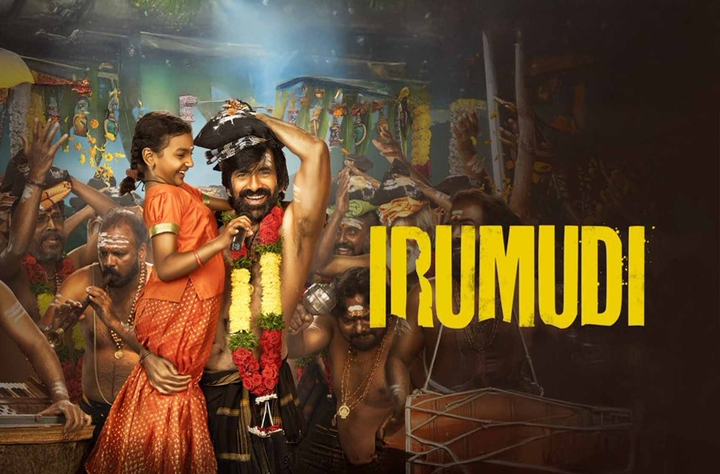
Movie Review: Irumudi (2026) – Ravi Teja Delivers a Powerful Comeback in an Emotional Father-Daughter Drama
Irumudi is a Telugu emotional action drama written and directed by Shiva Nirvana, featuring Ravi Teja in a restrained and emotionally driven role. The film pairs family sentiment with social drama, crime-thriller elements and an Ayyappa Deeksha backdrop.
The film stars Ravi Teja, Priya Bhavani Shankar, Baby Nakshathra, Sai Kumar, Swasika Vijay, Ajay Ghosh, Ramesh Indira, Rajkumar Kasireddy and others.
Released theatrically on August 21, 2026, Irumudi has a runtime of approximately 145 minutes. The film was released in Telugu and Tamil and has received generally positive audience reactions, particularly for Ravi Teja’s performance, the father-daughter relationship and the emotional climax. (Rotten Tomatoes)
Quick Review Overview
| Attribute | Details |
|---|---|
| Director | Shiva Nirvana |
| Writer | Shiva Nirvana |
| Additional Writing | Naresh Babu P. |
| Lead Cast | Ravi Teja, Priya Bhavani Shankar, Baby Nakshathra |
| Supporting Cast | Sai Kumar, Swasika Vijay, Ajay Ghosh, Ramesh Indira, Rajkumar Kasireddy, Meesala Lakshman, Ramana Bhargav, Karthik Adusumilli |
| Music Composer | G. V. Prakash Kumar |
| Cinematography | Vishnu Sharma |
| Editor | Prawin Pudi |
| Action Choreography | Ram–Lakshman, Real Sathish |
| Genre | Family Drama / Action / Thriller |
| Language | Telugu / Tamil |
| Runtime | 145 Minutes |
| Certification | UA 16+ |
| Theatrical Release | August 21, 2026 |
| Production | Mythri Movie Makers |
| Producers | Naveen Yerneni, Y. Ravi Shankar |
The film is directed and written by Shiva Nirvana and produced by Naveen Yerneni and Y. Ravi Shankar under Mythri Movie Makers. (Rotten Tomatoes)
Storyline: A Father’s Journey from Addiction to Redemption
At the centre of Irumudi is Trinadh, played by Ravi Teja.
Trinadh is an auto driver and small-business owner living with his young daughter in a rural setting. On the surface, he is a loving father, but he has a serious weakness—alcohol addiction.
His violent past and drinking habit have created problems within his family, particularly with his wife Kaveri, played by Priya Bhavani Shankar.
But Trinadh shares an exceptionally close bond with his daughter.
His daughter wants her father to change.
She doesn’t want him to drink anymore. She wants him to become a better person and, more importantly, wants to undertake an Ayyappa pilgrimage with him.
Moved by his daughter’s request, Trinadh decides to change his life.
He begins the 41-day Ayyappa Deeksha, giving up alcohol and attempting to rebuild his relationship with his family.
For a while, the story focuses primarily on this transformation.
Then the film takes a darker turn.
The second half introduces a crime involving the abduction of girls, forcing Trinadh to confront a dangerous situation in his community. His journey from an irresponsible alcoholic father to a protective parent becomes the emotional backbone of the thriller. (Baap Of Movies)
This gives the film two distinct identities:
First half:
Family drama + father-daughter relationship + personal redemption
Second half:
Crime thriller + action + social conflict
And that combination is both the film’s greatest strength and its biggest weakness.
Character Performances: Ravi Teja’s Most Restrained Performance in Years
Ravi Teja as Trinadh
Ravi Teja is the heart and soul of Irumudi.
Instead of relying heavily on his usual mass mannerisms, the actor chooses a much more controlled performance.
Trinadh is flawed.
He drinks.
He has anger issues.
He has made mistakes.
But he genuinely loves his daughter.
Ravi Teja successfully communicates this contradiction.
His emotional scenes with his daughter are particularly effective because he doesn’t overplay them. The quieter moments often work better than the film’s larger action sequences.
This is one of the reasons several early reviews have described Irumudi as a strong comeback for Ravi Teja. Critics have particularly praised his restrained performance and the father-daughter bond. (Rotten Tomatoes)
The performance is very different from the loud commercial roles audiences normally associate with him.
And that difference works.
Priya Bhavani Shankar as Kaveri
Priya Bhavani Shankar plays Kaveri, Trinadh’s wife.
Kaveri is frustrated by her husband’s alcoholism and unpredictable behaviour.
Priya brings a grounded quality to the character, especially during the domestic conflicts.
Her character isn’t merely there to support the hero. She represents the consequences of Trinadh’s addiction and the emotional damage it has caused his family.
Her chemistry with Ravi Teja is convincing, particularly in the more serious family portions.
Baby Nakshathra as Manikanta
The biggest surprise of the movie is undoubtedly Baby Nakshathra.
As Trinadh’s daughter, she has an emotionally demanding role.
The entire transformation of her father is motivated largely by his relationship with her.
Nakshathra handles the emotional scenes with remarkable confidence, particularly considering her age.
Her performance has received widespread attention, and Dhanush even personally praised the young actor over a video call, telling her that he would like to learn acting from her. (The Times of India)
That is a strong indication of how much her performance has resonated with audiences.
Sai Kumar
Sai Kumar brings veteran experience to the supporting cast.
His performance adds seriousness to the film’s family and devotional elements.
Swasika Vijay
Swasika Vijay contributes effectively to the emotional side of the story.
Her presence becomes more significant as the narrative expands beyond the central father-daughter relationship.
Ajay Ghosh
Ajay Ghosh plays Erraji, one of the important characters in the film’s darker second-half conflict.
He brings the intensity expected from a character involved in the crime-thriller portion.
Ramesh Indira, Rajkumar Kasireddy and Others
The supporting cast includes Ramesh Indira, Rajkumar Kasireddy, Meesala Lakshman, Ramana Bhargav and Karthik Adusumilli.
They help expand the film’s rural setting and social conflict.
The cast is one of the film’s dependable strengths. (IMDb)
Technical Craft & Direction: Emotion Before Mass Moments
Director Shiva Nirvana takes an interesting approach with Irumudi.
Instead of building the entire movie around Ravi Teja’s established mass image, he attempts to create an emotion-first family drama.
The director had previously described the film as a serious family story centred around the bond between a father and daughter, and specifically highlighted the intensity of the final 40 minutes. (The Times of India)
That intention is clearly visible.
Cinematography
Vishnu Sharma handles the cinematography.
The rural landscapes and waterfall locations provide the movie with a natural visual identity.
The setting is important because Trinadh’s life is closely connected to his community.
The film doesn’t depend on glossy urban visuals.
Instead, it uses:
- Rural homes
- Waterfalls
- Village roads
- Small businesses
- Temple and pilgrimage settings
This gives the family drama a grounded quality.
Music & Background Score
G. V. Prakash Kumar handles the music.
The music is one of the film’s technical highlights.
Songs such as “Irumudi Kattu” and “Mallepoola Pallaki” contribute strongly to the emotional and devotional atmosphere.
The background score is particularly effective during the later portions.
Several audience reactions have specifically praised the music and BGM. (Tenvow)
The devotional component also adds another layer to Trinadh’s transformation.
Editing
Prawin Pudi handles the editing.
This is where the film could have been tighter.
The film runs for approximately 145 minutes, and the first half takes considerable time establishing Trinadh’s family life and personal transformation.
While those portions are emotionally important, some scenes could have been shortened.
The second half also occasionally feels stretched because the screenplay moves from family drama into a much more conventional crime-action structure. (Rotten Tomatoes)
Critical Analysis: Two Different Films in One
The most interesting aspect of Irumudi is its tonal transition.
The first half is primarily about:
Father → Daughter → Addiction → Reform → Family
The second half becomes:
Crime → Abduction → Revenge → Protection → Action
The first half is arguably more emotionally successful.
The father-daughter relationship gives the film a genuine heart.
Trinadh’s decision to change because of his daughter feels believable, and Ravi Teja’s restrained performance strengthens that portion.
The second half, however, is more conventional.
The villains become increasingly exaggerated, and the crime-thriller elements aren’t always as nuanced as the family drama.
This criticism has appeared in reviews as well. Filmfare praised Ravi Teja’s performance and the father-daughter bond but felt predictable villains and uneven emotional beats prevented the film from becoming more powerful. (Rotten Tomatoes)
The Indian Express was considerably harsher, giving the film 2/5 and arguing that the second half needed a tighter script and more believable antagonists. (Rotten Tomatoes)
That difference in critical response is understandable.
Irumudi has a very strong emotional core, but the thriller surrounding it isn’t equally strong.
What Works
✅ Ravi Teja’s Performance
A restrained and emotionally convincing performance that moves away from his usual mass template.
✅ Father-Daughter Relationship
The emotional heart of the film.
✅ Baby Nakshathra
A standout child performance that adds considerable emotional weight.
✅ G. V. Prakash Kumar’s Music
The songs and BGM complement both the emotional and devotional portions.
✅ Strong Climax
The final stretch delivers the intensity promised by the director.
✅ Social Message
The film attempts to discuss addiction, parenting, women’s safety and personal responsibility.
✅ Emotional First Half
The family portions are grounded and often genuinely touching.
What Doesn’t Work
❌ Uneven Second Half
The transition from family drama to crime thriller isn’t completely smooth.
❌ Predictable Villains
The antagonists are less nuanced than the protagonist and family characters.
❌ Length
At around 145 minutes, certain portions could have been trimmed.
❌ Tonal Shift
The realistic family drama and commercial action thriller don’t always blend naturally.
❌ Some Forced Emotional Moments
A few scenes appear designed specifically to produce an emotional reaction rather than emerging organically from the story. (Rotten Tomatoes)
Final Verdict: Is It Worth Watching?
Irumudi is a sincere and emotionally driven family drama that becomes an uneven but engaging action thriller in its second half.
The biggest reason to watch the film is Ravi Teja.
His performance as Trinadh shows a different side of the actor. He isn’t constantly shouting or performing for the gallery. Instead, he plays a flawed father who genuinely wants to become a better person for his daughter.
Priya Bhavani Shankar provides solid support, while Baby Nakshathra is the film’s unexpected revelation. Her performance gives the father-daughter relationship its emotional strength.
The film’s other major positives are G. V. Prakash Kumar’s music, the rural setting, the emotional climax and the socially relevant themes.
The main weakness is the second half, where the movie moves into a more predictable crime-action territory. The villains are less convincing than the central characters, and the screenplay loses some of the realism established earlier.
Still, Irumudi succeeds where it matters most: it makes the audience care about its father-daughter relationship.
If you enjoy emotional family dramas, father-daughter stories, social thrillers, Ravi Teja’s performances and films that combine sentiment with action, Irumudi is worth watching.
Overall Rating: ⭐⭐⭐½ / 5 (Rotten Tomatoes)